uv printerzundillustratormimaki
[CoF] Careers of the Future
[TODO: gif of printing, gif of cutting]
Introduction
This workflow combines two of the TPZ Fab Lab’s largest machines: the Mimaki JFX UV printer and the Zünd digital cutter. These systems are built for production environments, and when they work together this pedigree shines through, yielding unmatched quality, consistency, and throughput. This tutorial will guide the reader around their first JFX-Zünd spiral, fabricating a professional-quality poster made of thick card stock, starting with file preparation and continuing through machine configuration and operation.
Prerequisites
This tutorial assumes:
- a basic working knowledge of Adobe Illustrator: using layers; drawing boxes; changing line weights and fills; resizing art boards and placed raster images; grouping and ungrouping items; and performing basic file manipulation, like saving *.pdf and *.ai documents. The reader is certainly encouraged to learn as they go, but starting with an introductory tutorial may be useful.
- guided or properly supervised access to the Mimaki JFX UV printer and the Zünd digital cutter: both machines require individual training and certification before independent use. Plan to book time with a technician; select the “JFX/Zünd” option and expect the first appointment to take at least an hour and a half.
Before Printing Day, the reader is kindly asked to make as much progress in file preparation as possible in order to use time most efficiently. Having said that, simply showing up with a nice *.jpg is certainly sufficient.
Process
File preparation in Adobe Illustrator
- Start with a high-quality image. The JFX is capable of printing up to 1200 DPI; however, many images still look fabulous at far lower resolution, particularly if they are graphical designs rather than photographs. As a rule of thumb, staying above 100 DPI is a good idea, so if you want to make a full-sheet poster (which means 20 in. x 26 in. using our current stock), start with a source file that is at least 2000 x 2600 px, or roughly 5 megapixels (MP). You will hit diminishing returns at 300 DPI or so, but feel free to bring enormous files if you have a beefy laptop and want to maximize; at the aforementioned print size, that means 24,000 x 31,200 px, or roughly 0.75 gigapixels (GP). Rasterized image files like *.jpg, *.png, or *.tif are best, and *.pdf files are usually fine. This example uses the spectacular JWST NIRCam/MIRI composite image of the Pillars of Creation from November 2022, which is available as a 7130 x 6675 px (~47.5 MP) *.tif:
 Fig. 1: mmm, delicious fresh stars
- Create a new document in Illustrator. First, click More Settings on the right of the New Document dialog:
 Fig. 2: click More Settings in the New Document dialog to adjust things like color space and profile.
In the More Settings dialog, drop down Profile and select Print:
 Fig. 3: drop down the Profile menu and select Print.
Now, set the Units to Inches, the Width to 20 in. (or 26 in. for a landscape), and the Height to 26 in. (or 20 in. for a landscape), The Color Mode should be CMYK by default, and Raster Effects should be High (300 ppi) by default; correct these if needed and press Create Document:
 Fig. 4: in the More Settings dialog, adjust units, width, and height, and verify color mode and raster effects before hitting “Create Document”.
- Place your image on the Illustrator document. Drop down the File menu and click Place, then click on the document to drop the image:
 Fig. 5: drop down the File menu and select “Place” to import your image into Illustrator.
 Fig. 6: the image after placing in Illustrator.
- Resize your image. Click the image and then click the Properties tab on the right side of the screen, or select Properties from the Window menu. Scroll up in the Properties tab to the Transform section. Ensure the “Maintain Width and Height proportions” button, directly to the right of the W: and H: boxes, shows a chain link; if the button has a line through it, click it to toggle mode. Now, change the smaller of the two values in W: and H: to 20 in., then roughly center the image on the artboard. Note that in this example the height was the smaller value, so the image was subsequently rotated 90 degrees using the Transform > Rotate command from the Object menu:
 Fig. 7: the image after resizing, rotating, and centering.
- Change the current layer name to “img”. In the Layers tab on the right side of the screen, double-click the layer name (probably “Layer 1”) to change it, then hit Enter.
 Fig. 8: rename the current layer to “img”.
- Add a box around the image. Select the Rectangle tool in the toolbox and click on the top left corner of the image, allowing the box to snap to the anchor point. Drag the rectangle to the lower right corner of the image where it will snap again and release the mouse button.
 Fig. 9: draw a rectangle around the image, allowing the tool to snap to the corner anchors so it fits perfectly.
- Change the box line weight to black and 0.25 pt, and the fill to None. Select the rectangle if needed and find these settings on the bar at the top of the screen, or on the Properties tab. Note that “None” is indicated by a white square with a red diagonal line.
 Fig. 10: change the box fill and outline so you can see the image again.
- If your art has printing to the edge, shrink the box by 0.02 in. (0.5 mm). With the box selected, drop down the Object menu and select Path > Offset Path:
 Fig. 11: locate the Offset Path dialog.
In the Offset Path dialog, type -0.02 in. in the Offset box and make sure the Preview box is checked. When a second path appears inside the first, press OK:
 Fig. 12: change the Offset to -0.02 in.
Select and delete the original box, leaving only the shrunken one:
 Fig. 13: delete the original box which matched the image size, leaving behind a slightly smaller box.
- Move the box to a new layer called “cut line”, above the “img” layer. Create a new layer, select the box, and drag the little square from the “img” layer to the “cut line” layer:
 Fig. 14: create a new layer called “cut line” above the “img” layer, and move the box to it.
 - Create a new layer called “registration” above the “img” layer:
 Fig. 15: create a new layer called “registration” above the “cut line” layer.
 - Add three 1/4” black dots to the “registration” layer. Locate the Ellipse tool on the tool bar; you may need to click on the triangle on the Rectangle tool button to find it. Drag an oval on the workspace and then use the Transform section in the Properties tab to set both W and H to 0.25 in. Change the Fill to black and the Stroke to None. Move the circle above the upper-left corner of the image, still on the artboard but not overlapping anything:
 Fig. 16: on the “registration” layer, create a 0.25 in. diameter black circle just above the top-left corner of the image.
 Copy and paste two additional circles onto the “registration” layer. Move one to the top right and one to the lower left of the image, staying on the artboard but avoiding any overlaps as before. Make sure you do not accidentally resize the circes while moving them; if you do, undo and try again:
 Fig. 17: create two additional 0.25 in. diameter black circles above the top-right and below the bottom-left corners of the image.
 - Double-check that the three layers have the correct things on them. Use the Show/Hide eye icon button on each layer to toggle them on and off until you are satisfied, and move things around if necessary:
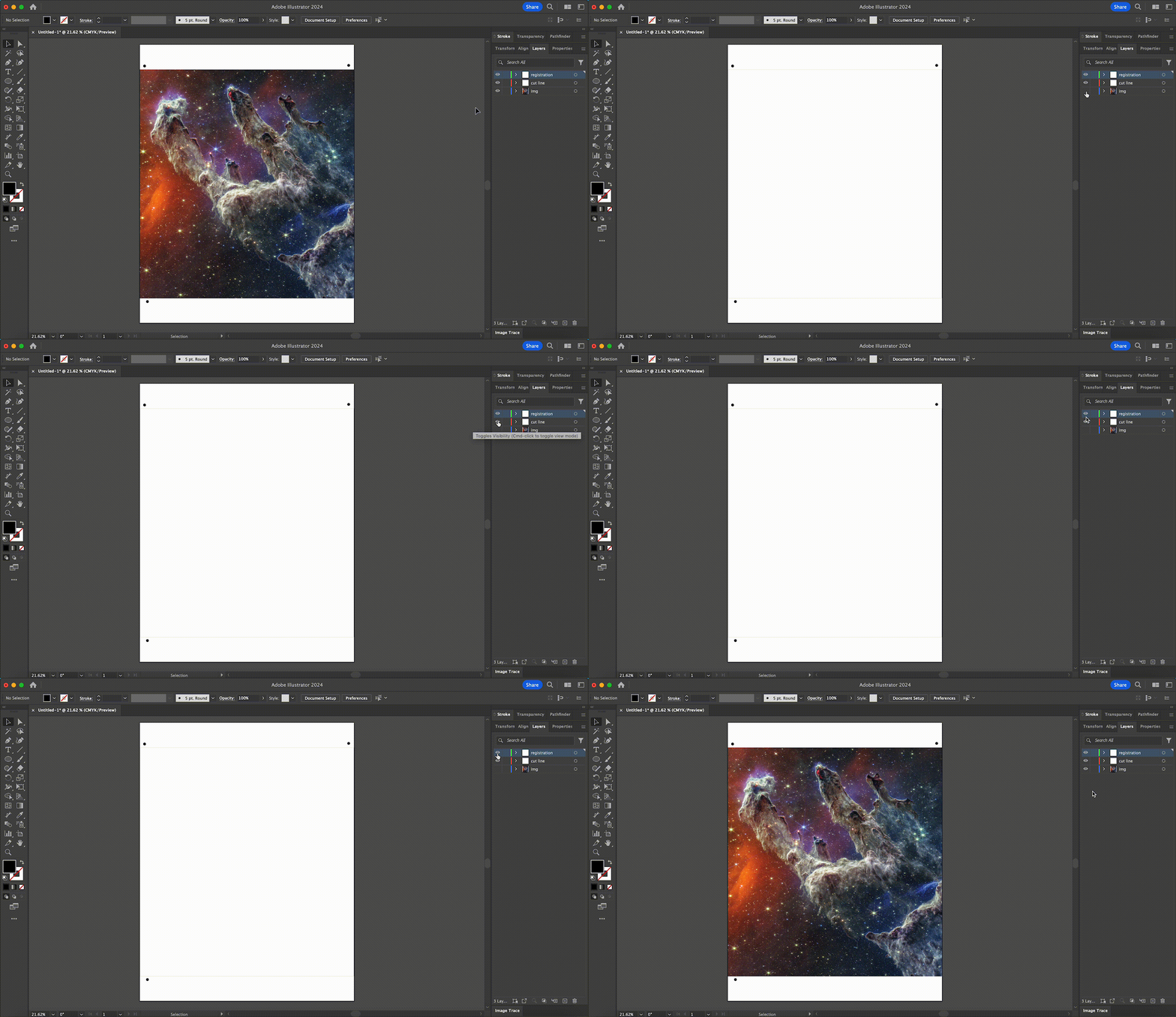 Fig. 18: double-checking each layer to make sure the right objects are in the right places.
 - Increase the artboard size to the actual paper size: 22 in. x 28 in. Deselect any items you may have selected. In the Properties tab, click Edit Artboards. Ensure the Transform reference point is in the center, and update the W: and H: values to 22 in. and 28 in. The white box around the image should increase in size by an inch on each side, keeping the image and reference dots centered:
 Fig. 19: scale the artboard with a center reference to 22 in. by 28 in., which should produce an equal 1 in. gap around the entire image.
 - With all three layers shown, save the file as a *.ai document. In the Layers tab, make sure all of the Show/Hide eye icon buttons are set to Show. Drop down the File menu and select Save. Choose a good file name (like “Pillars-of-Creation-Poster_cut.ai”) and accept the default save options.
- Hide the “cut line” layer and save the file as a *.pdf document. Click the Show/Hide eye icon button next to the “cut line” layer and double-check that the box disappears from the image. Drop down the File menu and select Save As. Choose another good file name (like “Pillars-of-Creation-Poster_print.pdf”) and accept the default save options.
- Copy both files to a USB stick or the appropriate shared drive. USB sticks are simple; if you prefer the network approach, make sure you choose a drive that is accessible by both the JFX and the Zünd. The Student and Staff Fab Lab drives are fine, but avoid logging onto your personal file repositories (such as Google Drive) on either computer.
UV printing with the Mimaki JFX
Cutting with the Zünd digital cutter
Multiple posters on one sheet
TODO
Duplicate sheets in one print run
TODO
Different sheets in one print run
TODO
Interesting substrates
TODO


